Many millions of women are being exploited in violation of human rights—and made invisible. Awareness and resistance must be networked. A call to action
Werner Rügemer
Millions of women are subjected to modernized slave labor, which is constantly expanding and at the same time made invisible. It is organized primarily by US corporations in poor countries on all continents. This applies to prostitution, of course, and not only to textile and food corporations, but even more so to the production of digital devices such as laptops and cell phones, to “deletion work” in (a)social media, to e-cars, to robot control and AI tools.1
Sugar slaves in India
And even if a particularly criminal form of slave labor becomes known in the short term, in already known areas, it is quickly suppressed. Here is an example: the Indian sugar workers for Coca-Cola, Pepsi-Cola, Unilever, and General Mills.
The beginning of the production chain for sugar in India is small plantations. The workers live in the sugar fields. The mostly very young women have to have their uteruses removed so that they do not interrupt their work due to pregnancy and childbirth. They have to pay for the operation themselves and go into debt to do so – this makes them even more vulnerable to blackmail, for minimum wages starting at $2 per day. And they have to pay off their debts for years.
Corrupt certificate business: Bonsucro
Sugar buyers such as Coca-Cola and Unilever know this, which is why they purchase certificates from professional certificate issuers. These certificates attest that the supply chain meets “our social standards.” Coca Cola, Unilever & Co. then go public with this: “We comply with our social standards” – they don't mention the specific human rights, labor rights, and social rights of the UN/ILO anyway.
In the case of these Indian sugar workers, the certificates were issued by the certification company Bonsucro. Bonsucro means “good sugar”: Bonsucro developed its methods in Brazil, the largest sugar-producing country, hence the name. The certification company is based in London and has its own chain of paid certificate issuers who carry out inspections „on site“ in countries such as India.
Corrupt certificate supply chain
But what does “on site” mean? India is the second largest sugar-producing country after Brazil, with thousands of small and medium-sized plantations: this is also a production chain in itself. The term “supply” chain is also an understatement here, because it involves heavy physical labor under slave-like conditions: production must take place before delivery can occur!
When a Bonsucro inspector is asked to issue a certificate, he goes to one of the plantations he knows to be a model plantation and after making an appointment, the corrupt inspector is taken to a plantation where, at least on that day, everything is in order: the workers smile friendly as instructed, and the corrupt foreman confirms: “They are very satisfied.”
Bonsucro is typical of such organized consultant corruption. Like many similar companies, Bonsucro began as a human rights non-profit initiative. It was then initially “supported” by the World Wildlife Fund, i.e. financed, and then, with the „human“ capital acquired from a human rights initiative, it became a profitable private company – like thousands of NGOs financed by the Gates, Soros/Open Society, Carnegie, Lilly, Bloomberg & Co. foundations.
Exposing corruption – no consequences
On one occasion, unusually, a local Indian authority conducted its own investigation and interviewed 82,000 sugar workers, documenting this slave labor, as well as child labor.
This briefly became a scandal and was even reported twice in the New York Times in 2024: “How audits missed abuses in India's fields,” NYT 1.8.2024, and “Revelations roil sugar industry,” NYT 23.8.2024.
But this revelation came to nothing in the US and the „western civilization“, and was not publicized in the EU and Germany, neither by governments nor by the EU – nor by the otherwise scandal-hungry leading media, which analyze the New York Times daily, nor by initiatives that have been involved in “supply chains” for years. And – silence from women's movements as well.
Modern slaves in capitalist metropolises
Modern slave labor, especially for women, also exists in capitalist countries themselves, in the metropolises: this slave labor originates from them and is made invisible here, not only globally, but also nationally.
USA: Illegal women as pillars of the economy
Low-wage female workers—both legal and illegal—are an essential pillar of the economy, especially in the USA, where they perform physically demanding work. They pay taxes, but at the same time they are deliberately blackmailed with deportation and kept in invisible low-wage jobs.
This is particularly true in 22 sectors such as slaughterhouses, agriculture, office services, fast food, catering, lounge services, medical assistance, personal care, private households, home care, domestic care, and animal care. Even a full-time job leads to poverty, let alone the part-time jobs that predominate here – surviving on a few food stamps, but no health insurance. And it affects especially women who are not white: the lower their status, the more direct the racism is associated with it.
And this is just as true under friendly, smiling presidents like Bill Clinton, Barack Obama, and Joe Biden as it is under Donald Trump, who openly persecutes migrants: Since 2014, the proportion of women in low-wage jobs that violate human rights has risen by 25%.2
Germany: “The brothel of Europe”
In the EU, as in Germany, millions of people are employed in low-wage jobs that violate human rights, for example in construction, delivery services, security, catering, seasonal work in agriculture, tourism, and domestic care. This is routine, EU normality. Many of these modern slaves are legal, but the vast majority are illegal: in Germany, 40,400 prostitutes were registered under the Prostitute Protection Act before the pandemic; after the pandemic, the number was 32,300 – not registered is the unrecorded, secretive majority, which is estimated to be ten times as large. Since and after the pandemic, the business has become even more invisible because it has shifted even more from brothels to apartments.
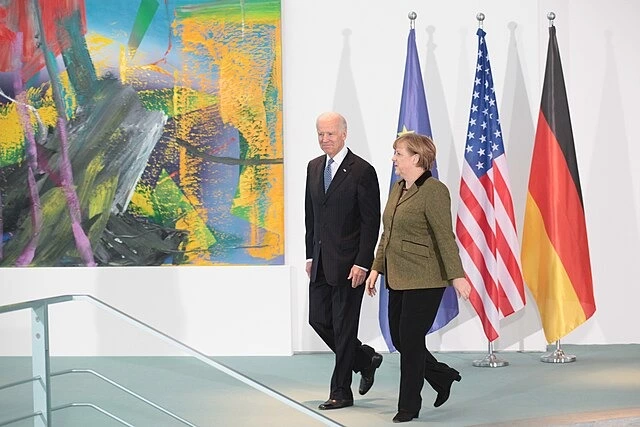
These young women, sexually exploited, from precarious backgrounds, often run by mafia-like organizations, come mainly from Eastern Europe, including Ukraine, and Asia – Germany has thus become the “brothel of Europe” under the four-term chancellorship of the Christian-leaning CDU chairwoman Angela Merkel.3
Ukraine: World leader in industrial surrogacy
In many respects, Ukraine, supported by the US and the EU, has been a major “beacon” since its “independence” in 1991. Thousands of suppliers to Western automotive, textile, pharmaceutical, and agricultural companies have taken advantage of the legal minimum wage, which was less than 1 Euro per hour until 2019 – now it is at 1,06 Euro.
This has also made Ukraine a global hot spot for industrial surrogacy—and this continues even during the war. The poverty and unemployment of many women provides an inexhaustible reservoir.
Vittoria Vita, La Vita Nova, Delivering Dreams, or the more prosaic BioTexCom—such surrogacy agencies in Kiev and Kharkiv advertise their services and their women worldwide. Catalogs offer attractive Ukrainian women to wealthy foreigners. The well-heeled surrogacy tourists come mainly from the US, Canada, and Western Europe.4
The prospective parents deliver eggs and sperm to one of a dozen special clinics. These are fertilized in a test tube. The genetically foreign embryo is then implanted into the surrogate mother. This practice was developed and legalized in the USA, but is much more expensive there: between $110,000 and $240,000. In Ukraine, the procedure is even less regulated, which is one reason why it is much cheaper, along with the fact that women's bodies are cheaper to rent here. A healthy baby costs between €39,900 and €64,900 here.
Prices vary depending on whether the prospective parents want a specific gender for their ordered baby or not: Without gender selection, BioTexCom charges €39,900, with two attempts to achieve the desired gender €49,900, and with unlimited attempts €64,900. The offers include hotel accommodation, the issuance of a birth certificate and a passport at the relevant consulate.
The surrogate mother receives a monthly bonus of between €300 and €400 during pregnancy, and after delivery of the product, the success bonus is increased to up to €15,000. In the event of a miscarriage, if the child is disabled or if its acceptance is refused, the surrogate mothers receive nothing.5
Apple: Tens of thousands of suppliers
In today's US-led capitalism, Apple is one of the richest companies in terms of profits and stock value. The largest Apple shareholder groups are the biggest capital organizers, such as Blackrock and Vanguard. Their annual billions in profits also come from global slave labor involving millions of people, espcially women.
21 million employees in 1,121 suppliers
The number of slave laborers employed by Apple is unknown, as Apple itself keeps it secret. No government regulatory agency is concerned with this issue.
Apple once reported a partial review of labor rights in 1,121 suppliers in 53 countries. It says that 21 million employees have been informed about their rights.6 These very limited rights do not comply with the human rights labor standards of the UN and the International Labor Organization, ILO. The rights defined by Apple itself state, for example, that employees may work up to 60 hours per week, have one day off every seven days, and receive “fair” wages.
Apple does not report how and whether compliance with these few, low and, in terms of wages, vague rights is monitored by the authorities on site. Apple prefers countries, regions and special economic zones where no controls are in place.
Apple: Tens of thousands of suppliers
Apple has “global supply chains with tens of thousands of suppliers on almost every continent... and more than 800 suppliers in Germany.”7 For a decade, since early 2009, Apple has had its iPhones manufactured primarily in China. This is because wages there were very low, in line with the post-colonial situation. However, wages in China have been and continue to be raised gradually and sustainably, despite fierce resistance from Apple & Co.8
That is why Apple has been fleeing China as quickly as possible for a decade. That is why, since the iPhone 12 model, iPhones have increasingly been manufactured in India. Apple is now on the iPhone 17.
Taiwan: Development of the most modern slave labor
Apple does not have a single factory of its own. Apple commissions the three largest contract manufacturers in the world in the field of microelectronics and the digital industry: Foxconn, Pegatron, and Wistron.
They are based in Taiwan. In the US protectorate of Taiwan, the most modern industrial slave labor was developed in the 1980s, initially under martial law on behalf of Silicon Valley corporations.
Foxconn, Pegatron, and Wistron then set up more and more branches in other countries: in Japan, South Korea, and initially mainly in China—but fleeing from there to Vietnam, the Philippines, Thailand, Laos, and above all, on a large scale, to India.9
Foxconn: World leader in modernized slave labor
Foxconn is Taiwan's largest corporation with 1.3 million employees.
The model of modern industrial slave labor, initially developed in Taiwan itself, is still maintained there today, on a smaller scale, including in local chip factories.
There are currently around 830,000 migrant workers in Taiwan, the majority of whom are women. They are recruited from poor Asian countries such as the Philippines, Vietnam, Indonesia, and Thailand. They have an inferior status compared to regular employees in Taiwan, including Foxconn employees:

*They pay into the pension system but must leave Taiwan before they can retire.10
This sophisticated model has been and continues to be exported globally by Foxconn, Pegatron, and Wistron. They organize a growing, invisible army of millions of slave laborers worldwide.
Foxconn has the important orders for the digital devices of Western corporations: for laptops, cell phones, headphones, graphics cards, multifunctional wristwatches, voice assistants (e.g., Alexa), circuit boards, power supplies, connectors, heat sinks, housings, game consoles, and motherboards. The orders come mainly from US digital corporations, including Apple, Nvidia, Microsoft, Facebook/Meta, Hewlett Packard, Dell, Intel, Amazon, Alphabet/Google, Cisco, Motorola, Netflix, etc., and of course the military.
Monitored mass accommodation
Foxconn & Co. keep the slave workers in mass accommodation that is monitored day and night, in shared rooms, often with bunk beds, in residential complexes with many thousands of female slaves.
The residential complexes are cut off from the outside world and may only be left with special permission. The use of cell phones is prohibited.
Foxconn also provides food and organizes daily transportation from the mass accommodation to the factory. Work is carried out in three shifts, including on Saturdays.
iPhones for Apple in India
This model is practiced today primarily in Asia, especially in the world's most populous country, India: It has the world's largest reservoir of unemployed, poor people, mostly young women. They are preferred for the physical work of the digital industry.
India does not have a uniform minimum wage. It starts at 30 cents per hour and goes up to 1 euro, depending on the state, region, and special economic zone, and then also varies according to industry and employee status. There are no checks: the Indian government attracts investors with low wages and no controls.
Young women: 88 cents per hour, with deductions
Foxconn operates most of its Indian factories in the Hindu state of Tamil Nadu, in the special economic zone of the city of Chennai.
Only women work in the lower ranks, mainly young women between the ages of 18 and 23. They are recruited by agencies from the particularly poor regions of India. These young women are willingly given away by poor families with many children.
Foxconn pays an hourly wage of 88 US cents, but only part of this is actually paid out. The costs of poor food, mass accommodation, and daily bus transportation are deducted from this amount.
Sick and replaced after three years
The three-shift operation, the barracks, the extremely limited social relationships, the poor health care, the cheap food, the daily transport back and forth between accommodation and factory, even at night – all this makes the women sick and exhausted. That is why they are replaced after a few years, and the employment agencies bring in new young poor women.11
The workers cannot defend themselves against this. They are not allowed to belong to a union. The majority of them do not have an employment contract. But unions from outside the company supported a strike in 2021 by several thousand of the 17,000 workers at a Foxconn factory in Chennai: the workers left the factory without permission and blocked roads. As a result, the mass accommodation was improved somewhat.
Trump: Bring production back to the US! Apple is not following suit
This type of globalization has been promoted by US administrations since the 1990s, especially by Democratic Party presidents William Clinton, Barack Obama, and Joe Biden.
Recently, Biden signed an agreement with Indian Prime Minister Modi in 2024: Foxconn built a new 12-story high-rise in Chennai with shared rooms for 37,000 young women. Due to protests, the rooms now only have 6 beds and no more bunk beds.12
US President Trump has called on Apple to bring the production of iPhones and other devices to the US – but Apple & Co. have no problem ignoring their president's demands: they co-financed his election campaigns and then his inauguration ceremony as president in the White House. Thus, slavery continues, as it does in the US itself.
US capitalists in Apple and Foxconn
The slave labor of Apple/Foxconn is a form of organization of the most modern, richest, and most brutal form of US-led capitalism:
And that will remain the case, regardless of who the US president is.
Ukraine: Reconstruction with a minimum wage of €1.06
Under US President Biden, BlackRock at the beginning of the war in Ukraine. became the coordinator for the “reconstruction” of Ukraine afer the war. BlackRock CEO Laurence Fink therefore enthused at the 2023 World Economic Forum in Davos: We believe in Ukraine's victory, and after the war, Ukraine will be “a beacon in the world for the power of capitalism.”13
And BlackRock CEO Fink is also part of the Trump administration's Ukraine negotiating team in 2026. Over the next decade, BlackRock is to invest or coordinate $800 billion in Ukraine for the “capitalist beacon,” including for the latest drone technology, which has now also been tested in war.14
In addition, zero-hour contracts are permitted in Ukraine: on-call work. This means that the number of working hours and income can sometimes be zero. There is no requirement to give reasons for dismissals.
Trump/BlackRock also promise many new jobs for this “reconstruction.” That is why the legal minimum wage in Ukraine was increased on January 1, 2026: it now stands at $1.23 per hour, or €1.06:15 A “beacon” – for BlackRock & Co.
How to raise awareness of modern slave labor and combat it?
Modern slave labor, with the majority of workers being women and young women, is part of the increasingly aggressive, war-preparing and war-waging US-led Western capitalism, which is investing even more aggressively as a result: in the profitably destroyed Ukraine, in the Congo, in the profitably destroyed Gaza Strip (Trump: “The Riviera of the Middle East”).
At the same time, this slave labor is tabooed and concealed in the ruling class's production of lies: not only by corporations and their shareholders, but also by governments, the EU, political parties, and even established trade unions.
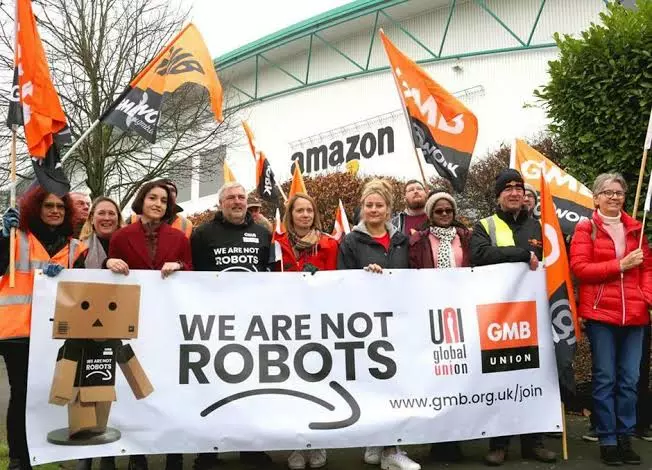
But in India and all the countries affected, trade unions, left-wing parties, and initiatives are active, including internationally networked trade unions such as UNIA, IndustriALL, and UNI Global in Switzerland.
Such initiatives exist in all countries, including the US, as well as in the poor countries of Asia, Africa, and Latin America. In Germany, labournet Germany, the Dortmund Trade Union Forum, the Hamburg Trade Union Left, and others have been active for many years. Such initiatives also exist in EU countries, in the west as well as the east, north, and south.16 And what if women's movements join in too?
How can joint action be possible? They would simultaneously oppose the wars, preparations for war, and regime changes currently being led by the US government under Donald Trump and carried out by its obedient accomplices, such as the German BlackRock chancellor Friedrich Merz.
The struggle for labor and social rights, including the struggle against the rampant modern slave labor of women, is part of the struggle for peace, democracy, justice, and security!
1 On the constant modernization of ever new forms of slave labor by the US, which was founded as a slave state, see: Werner Rügemer: Fatal Friendship, London 2025; also available in German, French, and Spanish editions, and soon in Greek, Turkish and Chinese.
2 Institute for Women's Policy Research: Undervalued and Underpaid in America. Women in Low Wage, Female Dominated Jobs, Report 2024
3 Germany – Europe's Pimp, Emma 1.1.2013; Germany has become Europe's brothel, t-online 12.9.2023; More prostitutes registered in Germany, zeit.de July 3, 2025
4 Business with baby happiness – Surrogate mothers in Ukraine, arte-TV January 29, 2021
5 Surrogacy in Ukraine: Invisible women between pandemic and war, Terre des Femmes July 30, 2023; Werner Rügemer: Ukraine – extreme pattern of neoliberal restructuring, in: Hannes Hofbauer (ed.): Consequences of war. How the struggle for Ukraine is changing the world, Vienna 2023, pp. 183-194
6 Apple: 2021 Annual Progress Report, p. 7
7 Apple relies on German precision work, FAZ May 17, 2023
8 Werner Rügemer: The Capitalists of the 21st Century, Hamburg 2022, pp. 275ff.; the book is also available in German, French, Italian, Russian, and Chinese editions.
9 Apple moves further into Asia. India and Thailand as a counterweight to China, FAZ 14.4.2023
10 Felix Lill: Eyesores on microchips. German car companies source most of their semiconductors from Taiwan, Amnesty Journal 1/2026
11 Asia as a workbench: “Traditional slaves were treated better.” Foxconn production for Apple in India, Deutsche Wirtschafts-Nachrichten, June 29, 2024
12 Werner Rügemer: Labor and capital – and a whole lot of culture in between, nachdenkseiten.de, February 12, 2024
13 https://kyivpost.com January 20, 2023
14 Art of the (peace) deal: Ukraine teases $800 billion economic peace plan to keep Trump on side, The Kyiv Independent January 8, 2026
15 en.wikipedia.org/wiki/list_of_countries_by_minimum-wage, accessed January 16, 2026
16 Werner Rügemer: Imperium EU - Labor Injustice, Crisis, New Resistances, Hamburg 2022
Editor's Note:
The views and informations expressed in the article are solely those of the author and may or may not reflect the views of The International. We believe in providing a platform for a range of viewpoints from the left.
"The International" belongs to you.✕
Please take a moment to read this. We apologize for any interruption, we want you to know "The International" seeks your valued support at this time. We've proudly served as a pioneering online platform, delivering ad-free media content. With only 2% of our readers opting for a subscription, any contribution you choose holds immense significance—whether it's an annual fee of $25 or a monthly payment of $2.5. — The "The International" Team, committed to providing you with enlightening perspectives. We want to highlight that this sum is even less than what you'd spend on a cup of coffee, yet it greatly aids in sustaining our efforts to perpetuate and enhance your esteemed initiative.