In his song Guns of the Viet Minh, communist hip hop musician Marcel Cartier wrote:
U.S. rulers in a frenzy and panic
Start to send soldiers into the battle
But the problem was these troops didn't have
A tenth of the willpower that their opponents had
This reflect’s Mao’s statement that “Weapons are an important factor in war, but not the decisive factor; it is people, not things, that are decisive. The contest of strength is not only a contest of military and economic power, but also a contest of human power and morale. Military and economic power is necessarily wielded by people.” What a paradigm-shifting impact it had when the Viet Minh applied this principle to defeat the United States within their nation.
It was after the Vietnam War that U.S. imperialism’s irrevocable decline from its post-World War II status noticeably began. The costs which added up from Washington’s failed attempt to crush communism in Vietnam, along with the blowback from the 1973 oil embargo that was made in response to Washington’s unwavering support for Israel, triggered an economic crisis whose legacy has since been quietly weakening the entire imperialist power structure. To keep profits up amid the suddenly falling rate of profits, the global capitalist class implemented neoliberalism, a system that’s only served to temporarily hold off capitalism’s collapse; in the last half century, wealth inequality and worker exploitation have ballooned so much because of this late-stage imperialist economic model that a new wave of socialist revolutions within the Third World is now likely imminent.
This domino effect of imperial decline has lately been playing out most notably in Latin America, where due to the cruelty of neoliberal austerity and neo-colonial overexploitation, multiple countries are in the process of liberating themselves from Washington’s grip. In Ecuador, an anti-IMF candidate just won the latest presidential election, which will force the empire to either attempt a half-baked coup or submit to the country’s indigenous resistance movement. In Bolivia, the Movement for Socialism defeated the country’s U.S.-installed coup regime a few months ago after waging resistance against extreme state violence. In Chile, Colombia, and a growing number of other neo-colonies, protest waves keep breaking out in response to the latest austerity policy or incident of police violence. India, which would be a gargantuan loss for the imperialists if it were to go socialist, is one of these increasingly restless neo-colonies. Class tensions are on the verge of spilling over.
How will the global proletariat manage to throw off imperial control? The key lies in looking to the place where one of the catalysts for the empire’s decline occurred: Vietnam. The Viet Minh’s struggle portends to what we’ll have to face when the class war comes to a head in our corner of the global capitalist power structure. Their means for prevailing reflect the kind of approach we’ll have to adopt in order to do the equivalent of what they did, to overcome a far more militarily equipped enemy through willpower and morale.
An important thing to note about the mindset of the Viet Minh is that in spite of the deprivation and strain they endured as fighters in their war for liberation, research shows that their morale wasn’t brought down by their circumstances. A 1964 study on the day to day conditions of the Viet Minh forces from the RAND corporation reports about the morale of these forces:
A slogan which recurs in our interviews is that the VC [Viet Minh] “lives splendidly and dies gloriously,” because he fights for a cause. Materially, of course, their life is miserable. Most of the fighting men are given one and a half lon of rice a day, a lon being a measure of volume the size of an ordinary condensed milk can…rest and sleep are usually inadequate because VC units ordinarily move and fight by night…Although living conditions are harsh, they do not appear to have lowered morale appreciably. In fact, morale seems to have improved over the long run.
There’s the crucial part, the part that drove the imperialists out of Vietnam and helped kickstart a downward spiral for U.S. hegemony: the unshakable confidence of those who faced down the empire, despite this having demanded such sacrifice on their part. As the Christian Science Monitor wrote in 1980:
Despite this formidable array of military might, the VC and NVA (he regards them as one and the same) managed to survive what he describes as "the most continuous and intense firepower ever directed against any army." Morale, Colonel Henderson concludes, was the key to the Vietnam war. No amount of napalm, defoliants, gunships, or B-52 strikes, it seems, could make up for the stamina displayed by the communist forces, whom he refers to as the People's Liberation Army (PLA) -- the name they preferred for themselves. Among US forces, combat power "eroded significantly" as deteriorating morale led to drug abuse, "combat refusals," and even "fraging" (killing of US officers by their own men), Colonel Henderson writes.
Why did morale among the Viet Minh remain so high? Because the PLA designed its operations to make its troops not just as militarily equipped as possible, but as psychologically invulnerable as possible. They standardized the three-man cell, which worked as a buddy system. They had cadre leaders who were charged with keeping their fighters ideologically on the side of the struggle. They had a policy which enabled troops to speak about and criticize battle plans. They had a practice of instilling their troops with a strong desire to keep “face” amid the sacrifices they were making, and therefore seemingly have a stoic attitude. Their battle philosophy even as much as emphasized stoicism, with a fatalistic attitude having served to keep their minds at peace in the face of risk and hardship; reflecting this philosophy, Vietnamese scholar Nguyen Kyen wrote that “Life is endless disillusion. Success, failure, gain, loss are not worth a jug of wine.”
These factors, wrote Colonel Henderson about why his imperial forces couldn’t overcome the Viet Minh, produced a dynamic where the communists were psychologically equipped to keep fighting no matter what:
The soldier was never allowed to be an individual and was constantly [reminded] of his duties to his two buddies, to the unit, to the country, and to the party. There's a real lesson there for almost any army that wants to observe it, and that is that unit cohesion makes armies impervious to all sorts of things -- stress in combat, hardship, lack of food, sleep, and so on. One of our biggest shortcomings, I think, is the turbulence in personnel policy that in many cases creates units of strangers. As long as you have units of strangers you can't have good cohesion. It's this cohesion that makes an army able to resist.
Will you ever be in a situation that directly resembles what the Viet Minh had to face? Whether you do, or you only come across an environment like the besieged encampment at Standing Rock or the police brutality-filled U.S. protests of this last year, you’ll have to reckon with physical danger or lack of modern comforts as a committed revolutionary. And when you do encounter these obstacles, it’s crucial that you’ve already joined, started, or helped properly mold an organization which can psychologically strengthen you like the PLA did for its members.
Study the organizational structure of the Viet Minh, and model your own organizing after it. Then the side of proletarian revolution will be equipped to weather the chaotic period of transition which is going to come between when the empire falls, and after socialism has risen in its place.
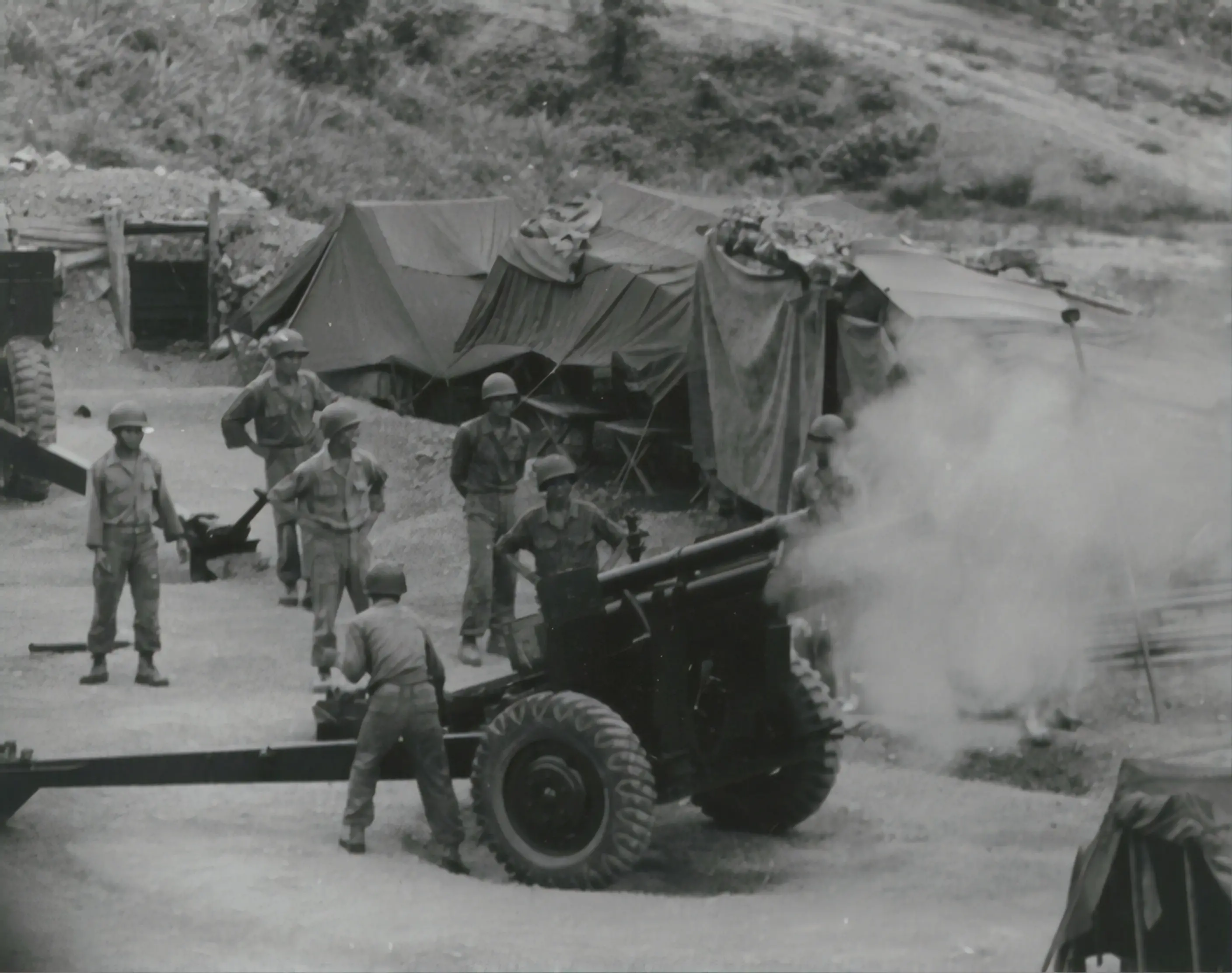
Photo by The New York Public Library on Unsplash