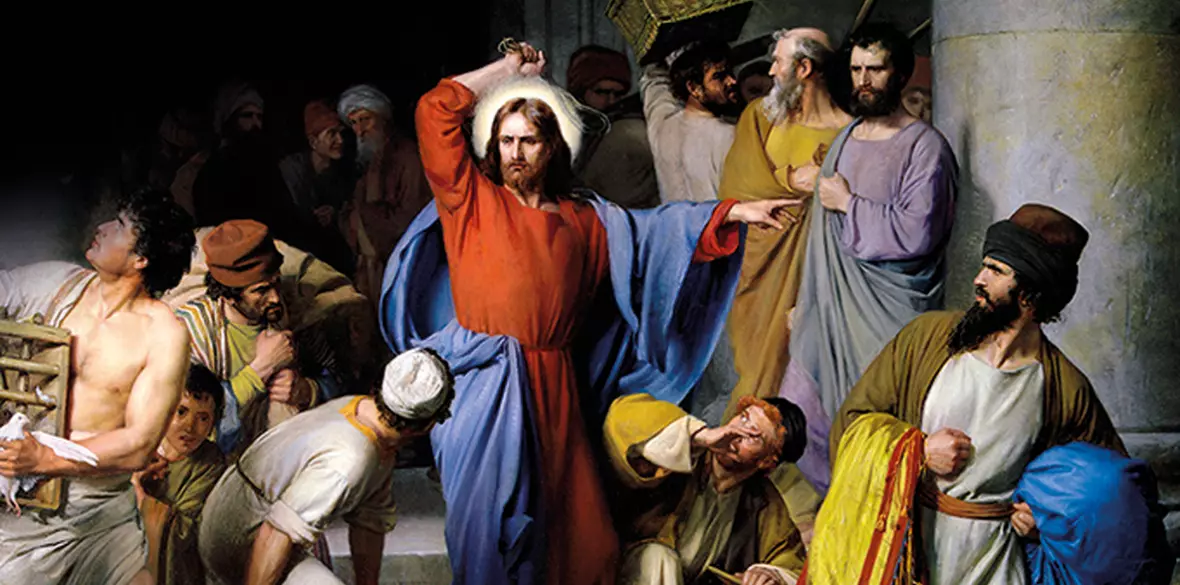
We know that Christ was a radical egalitarian from his proclamations in the Bible — but the Christmas myth is itself shot through with class consciousness and faith in an emancipated future for all the oppressed, writes REV TIM YEAGER
CHRISTMAS time can be so depressing. It brings out some of the worst features of capitalism and rubs them in our faces. You can’t escape, whatever your philosophical or religious belief.
Advertisements spur feelings of guilt if you don’t buy enough of the right kinds of consumer products for the people you love. Creative financing is offered so that lenders can make even more profit.
And it is an environmental disaster: more plastic, cardboard and packaging is produced, carted about, and dumped into landfills or incinerators at Christmas time than at any other time of the year.
And yet… Nearly smothered beneath piles of gift catalogues and sale circulars, nearly drowned in a sea of elevator-music Christmas carols, in a locked theological vault guarded down through the centuries by legions of preachers, priests and pontiffs, there burns a persistent secret flame.
It is the flame of a revolutionary hope — hope for a better world, a more just society, where the social order is turned upside down so that the poor are fed and the rich are relieved of their ill-gotten gains. And it is something that working people of any culture, any religious or philosophical background can relate to.
What does Christmas have to do with the class struggle? In a word — everything. The story goes like this:
Once upon a time, in a land far away on the edge of a great empire, there was a people with an ancient culture, a storied past, and a great literature, who had been conquered by a technologically advanced imperial power.
They were occupied by foreign soldiers and ruled by corrupt local despots who collaborated with the foreign oppressors. There were periodic revolts of local peasants and slaves that were put down mercilessly.
In the midst of all that, a young unmarried girl becomes pregnant out of wedlock. You might think she would regret this development, but on the contrary, she finds in the anticipated birth of a child a reason to rejoice and hope for a better world. In her joy and determination, she sings an ancient song of liberation:
My soul magnifies the Lord, and my spirit rejoices in God my Saviour, for he has regarded the low estate of his handmaiden. For behold, henceforth all generations will call me blessed; for he who is mighty has done great things for me: He has shown strength with his arm, he has scattered the proud in the imagination of their hearts, he has put down the mighty from their thrones and exalted those of low degree; he has filled the hungry with good things, and the rich he has sent away empty. (Luke 1:46-53)
She and her fiance are then forced to make a difficult journey while she is in the last weeks of her pregnancy, ostensibly to comply with the demands of their imperial rulers to register for a census.
They are denied lodging in local inns. Homeless, the young family takes shelter in a stable, where the mother goes into labour and gives birth to a baby boy among barnyard animals.
Hardly an auspicious beginning for a child in whom his mother had placed such hope. And then things get worse. The local ruler, a collaborator who is kept in power through the occupying army, decides on an act of terror. Convinced that a revolt is brewing in the village where the young couple has just had their baby, he sends in death squads to kill all the male children under a certain age.
Fortunately, the young family is tipped off and they flee into a neighbouring country. There they wait until they receive news of the death of their corrupt local despot, and then return to raise their son in their hometown.
When he grows up, the boy becomes a carpenter. As if to fulfil the revolutionary hope expressed in his mother’s song, he goes on to organise a movement for social and economic change. It is composed of a coalition of fishermen, former prostitutes, the unemployed, and low-level public servants, with a cross-section of men and women of different ethnic backgrounds.
The aims of the movement are clear from the very beginning:
“Prepare ye the way of the Lord, make his paths straight. Every valley shall be filled, and every mountain and hill shall be brought low, and the crooked shall be made straight...” (Luke 3:4-5).
“He has anointed me to preach good news to the poor. He has sent me to proclaim release to the captives and recovering of sight to the blind, to set at liberty those who are oppressed, to proclaim the acceptable Year of the Lord.” (Luke 4:18-19)
And so, when you look at the Christmas story closely, you find a story of working-class people living in difficult times, in circumstances not too different from those faced by millions of people today.
These are people who are aware of their history of struggle. They draw strength from the lessons of the past and nourish hopes and dreams for a better world.
Mary, the young mother in the Christmas story, is supremely confident that the future will be better. Her song, known as the Magnificat, is nothing less than revolutionary.
This revolutionary aspect of Christmas is also found in the popular Christmas carol O Holy Night (Cantique de Noel). The words were written by the French socialist Placide Cappeau de Roquemaure and it was translated into English by the American abolitionist John Sullivan Dwight. The music was written by Adolphe Charles Adam, a friend of Cappeau’s.
One verse of the carol states: “Truly he taught us to love one another; his law is love and his gospel is peace. Chains shall he break, for the slave is our brother; and in his name, all oppression shall cease.”
The political ramifications of this carol were well understood by some reactionaries in the US — where it continues to be controversial. The song was banned for years in many conservative US churches and many radio stations in the South refused to play it.
So, whenever you get weary of the holidays and all the claptrap that surrounds them, remember the young family of the Christmas story, how they hoped and dreamed for a revolutionary transformation of their country and how they persevered in the face of oppression.
Whoever you are, have a merry — and revolutionary — Christmas. And let us then enter the new year resolved to wipe out homelessness, poverty, racism, and injustice once and for all.
Former US union organiser and civil rights activist Tim Yeager is now associate priest at St Albans Cathedral.
This article originally appeared in People’s Weekly World in December 1999.